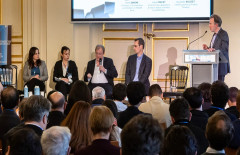
As part of the activities of the Risk Forum 2026 organized by the Louis Bachelier Institute, which was dedicated this year to the theme "hidden financial risks", a round table entitled: "Measuring geopolitical risks and their impact on investment and financing portfolios" was held, with the participation of a group of academics and financial experts, with the aim of discussing the increasing relationship between geopolitical tensions and global financial stability.
The session was chaired by Professor Charles-Albert Lehalle, Professor of Applied Mathematics at the Center for Applied Mathematics (CMAP) at the Polytechnic School – Polytechnic Institute in Paris, following a scientific presentation by Professor Matteo Iacoviello of the US Federal Reserve.
And the panelists included Dorothée Rouzet, Sébastien Jean, Anna Simoni and Julien Pincet, who provided complementary analyses on systemic vulnerabilities in the global economy, ways to measure geopolitical risks, the role of data and artificial intelligence, as well as practical implications for financial asset management.
Global Risks Escalating and the Disintegration of the International Economy
Participants discussed the global context of escalating trade tensions, strategic rivalries between major powers, increasing cyber threats, as well as the acceleration of the disintegration of global value chains.
Speakers stressed that these developments impose the need for new analytical tools capable of understanding how geopolitical shocks are transmitted across the global economy, and their direct impact on financial markets and international financial stability.
Identifying systemic weaknesses in the global economy
Dorothy Royer highlighted a number of vulnerabilities that could multiply financial risks globally, most notably:
Rising market valuations, especially in the US technology and artificial intelligence sector
Historically high levels of public debt in many economies
Rapid growth of non-bank financial institutions
Cyber attack risk escalates
And these factors add to the vulnerability of the global financial system to sudden shocks.
Transmission of geopolitical shocks across supply chains
Sebastian Jean touched on how geopolitical risks are transmitted through global value chains, noting that these risks are no longer just political events, but are a direct result of strategic decisions made by countries and economic actors.
And global markets are increasingly divided by export restrictions and new industrial policies, deepening the international economic disintegration.
Development of new risk indicators
Anna Simonyi discussed the challenges associated with developing indicators that can detect "weak signals" of geopolitical risks early.
And modern data sources—including market data, texts, and macroeconomic indicators—have become key tools in this area, along with the growing role of artificial intelligence and machine learning technologies in analyzing big data and extracting hidden patterns.
Asset management in a turbulent geopolitical environment
Julian Pansier presented the vision of institutional investors in the face of global uncertainty, stressing that traditional diversification strategies are no longer sufficient.
He called for a review of portfolio management by:
Focus on supply chain risks
Enhancing the security of financial infrastructure
Assess operational risks related to the custody of financial assets
Towards a Scenario-Based Approach
The discussion concluded that financial risk management is undergoing a radical shift, as institutions move from traditional models based on linear projections to models based on multiple scenarios.
This shift aims to enhance the ability to anticipate potential shocks, and increase the resilience of the global financial system in the face of an environment of heightened uncertainty.
Summary of the report
The debate underscores that the relationship between geopolitics and financial stability is more interconnected than ever, and that the global financial system is entering a new phase that requires more advanced analytical tools, combining big data, artificial intelligence, and scenario approaches, to confront a world of increasing risks and multiple sources of instability.






comments