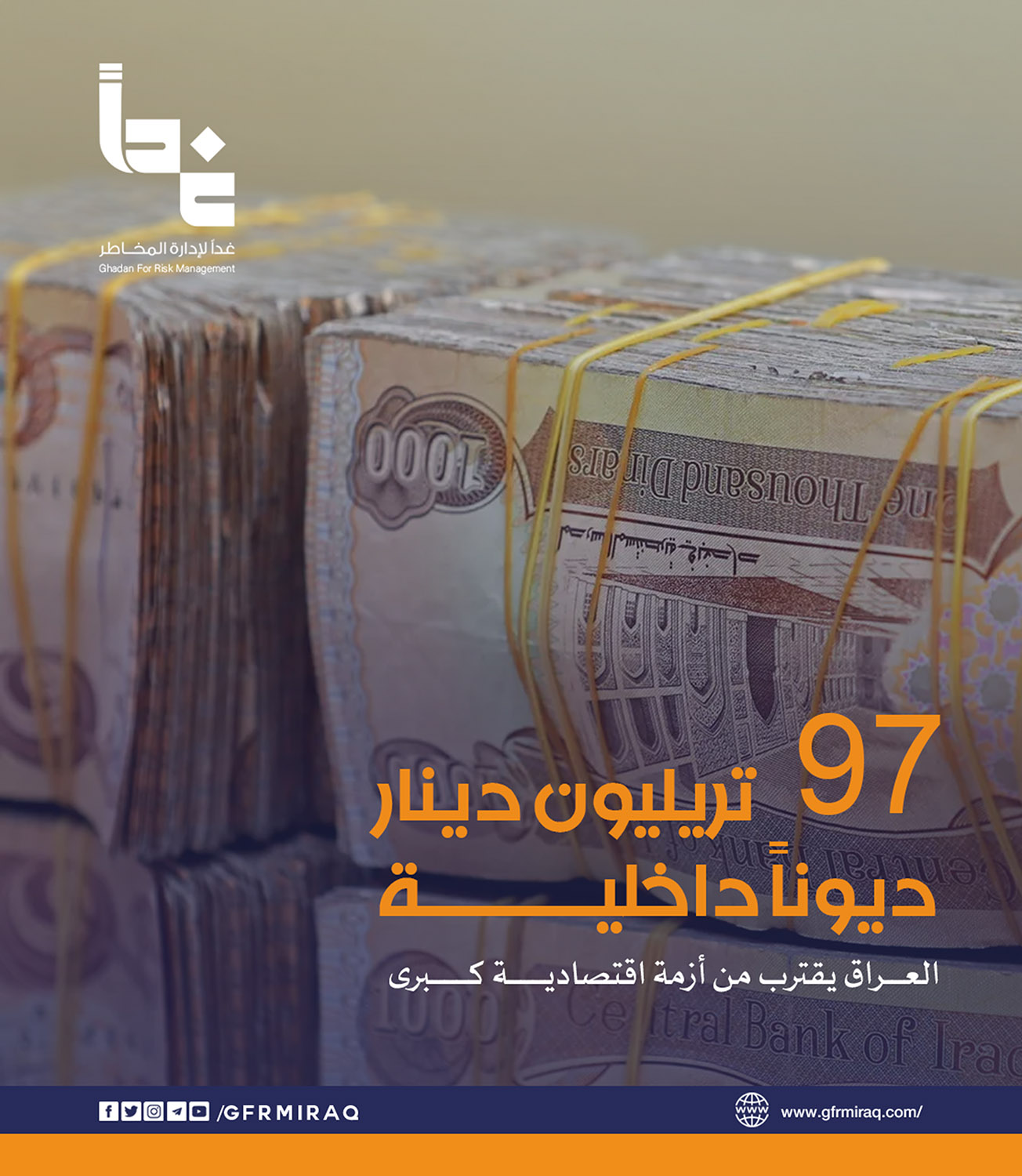
The financial situation in Iraq is facing a difficult test as the pace of internal borrowing escalates to record levels in a short period, raising concerns about the sustainability of the financial balance and the stability of economic conditions. And in this context, economic expert Nabil al-Marsoumi revealed, through a post on the "Facebook" platform, that the internal debt rose to 96.6 trillion dinars, while the foreign reserves of the Central Bank fell by more than 3 trillion dinars within two weeks, which put the file of the "financial deficit" under the microscope of analysis and research.
Dr. Sadeq al-Rikabi, director of economic research at the International Center for Development Studies in the United Kingdom, said that the rise in domestic debt and the decline in reserves "constitute a double pressure on the Iraqi economy," noting that future budgets "may move more towards debt repayment and debt service, instead of financing development projects, infrastructure, education and health."
And pointed out that the increase in internal borrowing "will withdraw liquidity from local banks," which weakens the ability of the private sector to obtain the necessary financing for its projects, explaining that banks "will prefer to lend to the government as a guaranteed repayment," which will lead to a decline in investment and high unemployment rates.
And he added that the continuation of this path "will affect the government's ability to finance the operating budget and even salaries," warning that the rise in the monetary bloc will lead to inflation and weak confidence in the Iraqi dinar, which drives towards increasing dependence on the US dollar within what is known as "the dollarization of the economy."
And Rikabi stressed that investors are looking with concern at the depletion of cash reserves and the increase in internal debt, because this may lead to the imposition of new taxes, cash restrictions and fluctuations in the exchange rate, which reflects negatively on the investment environment and the confidence of international companies and financial institutions.
Al-Rikabi proposed a number of solutions, the most prominent of which is the trend towards productive projects in industry, agriculture, services, and manufacturing energy, which creates sustainable non-oil revenues and reduces dependence on the rentier economy. He also stressed the importance of reforming public spending, fighting corruption, encouraging partnership with the private sector, and establishing sovereign funds to be used to confront economic crises and shocks and reduce the need for internal borrowing.




comments