AuthorHe is an economist and development analyst, and a member of the Iraqi Economists Network. He holds a master's degree in public policy economics from the Barcelona School of Economics. Mohammed's research focuses mainly on Iraq's energy sector and private sector development. His work has been published in prominent Iraqi and international publications, including the Iraq Oil Report, the Washington Institute for Near East Policy, and Foreign Affairs and Foreign Policy magazines.
publisher: IRIS
History: February 2026
translation Tomorrow Foundation for Risk Management - Nasr Muhammad Ali
After a hiatus of more than two years, oil exports from the Kurdistan Region of Iraq via Turkey resumed in September 2025. These shipments are linked to a transitional arrangement under which the Iraqi federal government will market and sell crude oil produced by the Kurdistan Regional Government (KRG) and international oil companies in exchange for allocations from the general budget. This paper is concerned with showing whether the oil-for-budget agreement represents a sustainable “win-win” solution, or merely a temporary financial solution. It also assesses whether this agreement will lead to a situation in which the public finances of the Kurdistan region can be significantly stabilized, even if it does not resolve the deep legal and political disputes over the oil authority that is at the heart of the conflict The agreement is an integral part of the three-year federal budget law, which seeks to address a practical problem: how to resume oil exports and enable the Iraqi government to pay the salaries of KRG employees and retirees.
· The Federal State Oil Marketing Organization (SOMO) exports crude oil from the Kurdistan region through the Iraq-Turkey pipeline. This part was successfully implemented, and exports continued for more than three months under this arrangement.
- In exchange for the KRG ceding control to the federal government, the KRG receives regular transfers from the budget to enable it to pay public sector salaries. However, Erbil is supposed to provide financial statements and a portion of its non-oil revenues. This part has been partially implemented, the payments are still irregular.
· The agreement includes a temporary framework for global oil company payments and cost recovery, with $16 per barrel set aside as a temporary value for global oil producing companies. This arrangement is linked to amendments to the General Budget Act, and is set to remain in force until a third party assessment is taken forward. This aspect has come into effect, as the initial payments have already been disbursed.
· Wood Mackenzie Consulting, a third party, will conduct an independent assessment to determine production and export costs. The company is expected to assess costs and help regulate payments, which would limit informal negotiations. The direct benefit of the agreement is the settlement of cash flows, which has improved conditions for both the KRG and international oil companies. "For the KRG, resuming exports is a tool for macro-level stability, not just an energy-related decision." For international oil companies that previously sold on the domestic market at very low prices (around $30 per barrel), operating within a cost-recovery framework of $16 per barrel is a clear improvement However, these direct effects only cover part of the picture, and there are other financial, institutional, and political implications.
Impact of the agreement on the Kurdistan Regional Government and the Iraqi Government
One way to assess the impact of the agreement on Baghdad and Erbil is to compare three possible fiscal paths for both the KRG and the Iraqi government: 1) a baseline scenario where the agreement is not implemented and cooperation collapses, 2) a pessimistic scenario where there is partial compliance and limited cooperation, and 3) an optimistic scenario where cooperation on oil exports and salary payments continues in the long run.
The most basic scenario is based on historical data, where the duration of the export interruption shows how sensitive the KRG's public finances are about access to the Iraq-Turkey pipeline. "For Baghdad, such a collapse would lead to renewed disruption to northern exports, reduced revenue predictability, and a return to temporary political bargaining over budget implementation." This outcome would lead to deteriorating cooperation, significant revenue losses, and broader macroeconomic distortions. In this context, transfers between the federal and regional levels will become politically contentious when the federal finances are under pressure. And on the ground, this tension is manifested primarily in the KRG’s cash flows, where the delay in payment is immediate and very clear, and provokes an angry popular political reaction. And over the past two years, the KRG has effectively lost the equivalent of three months’ salaries, or more than 12% of its actual financial entitlements to the KRG. The pessimistic scenario envisages a situation in which the KRG continues to pay salaries irregularly, with investment and development spending remaining limited. "For Baghdad, this scenario maintains stability in the short term, but at the expense of continued financial pressures, slowing reform momentum, and continued reliance on temporary arrangements rather than institutional solutions." The current economic situation in Iraq is characterized by increasing pressure on the budget, and the continuation of rent-seeking movements that affect the formation of the government and its political options. In light of these dynamics, the pessimistic scenario seems to be the most realistic, and the partial compliance scenario seems likely in the near term. It is also the scenario in which the agreement continues, but without achieving the deeper financial or institutional transformation that both parties ultimately need. For the KRG, the financial gains (shown in Figure 1) are clear: improved cash flow stability, reduced political volatility associated with wage payments, and a gradual shift from crisis-driven financial management toward a lower level of predictability. "This scenario could also pave the way for a more sustainable settlement if the two governments - particularly the KRG - remain committed to the financial and technical terms of the agreement," said Ahmed Hajj Rashid, a veteran Kurdish member of the Iraqi parliament's Finance Committee.
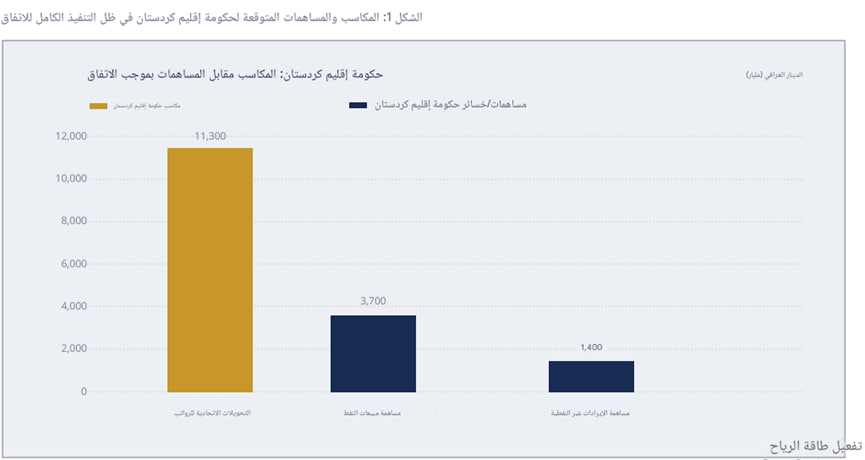
These figures were estimated under the full implementation scenario of the agreement, where the Government of Iraq fully funds the salaries of KRG employees, the KRG fully commits to federal contributions and provides oil at current production levels (188,000 barrels per day for export and 50,000 barrels per day for domestic consumption). These figures are indicative and vary according to political and market dynamics. And while salary transfers and non-oil revenues will only be implemented for 10 months in 2025, the calculations assume 12 months for clarity under the full-year scenario. The estimates are based on publicly available monthly data from the Iraqi Ministry of Finance, the General Oil Authority of Iraq and SOMO.
As for Baghdad, The expected gains from the optimistic scenario vary, but they are no less important. In addition to improving control of northern oil flows through the Iraqi Oil Marketing Company (SOMO), the resumption of exports provides the Iraqi-Turkish pipeline Iraq is strategically diversifying its crude oil export routes, reducing its near-total dependence on Basra's southern terminals. This is all the more important at a time when security risks in the Gulf – and the consequent disruption of traffic through the Strait of Hormuz – remain a serious macroeconomic vulnerability for Iraq. By maintaining access to Mediterranean markets, the Iraqi government reduces the risk of export concentration, improves revenue flexibility, and reduces the likelihood of regional security shocks. The arrangement also allows SOMO to expand its market share by responding to rising market demand in the wake of the European embargo on Russian oil by partially substituting paper ore.
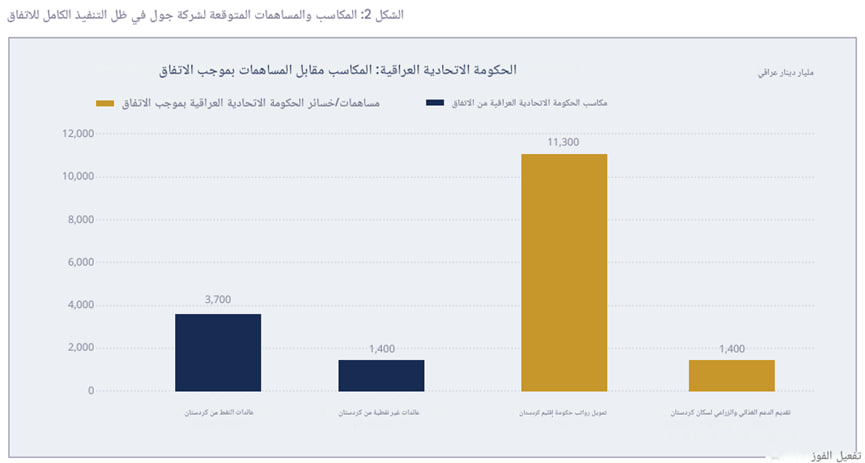
These figures were estimated under the full implementation scenario of the agreement, where the Government of Iraq fully funds the salaries of KRG employees, the KRG fully commits to federal contributions and provides oil at current production levels (188,000 barrels per day for export and 50,000 barrels per day for domestic consumption). These figures are indicative and vary according to political and market dynamics. And while salary transfers and non-oil revenues will only be implemented for 10 months in 2025, the calculations assume 12 months for clarity under the full-year scenario. The estimates are based on publicly available monthly data from the Iraqi Ministry of Finance, the General Oil Authority of Iraq, and SOMO.
A win-win deal
The deal becomes “win-win”, in economic terms, when both parties approach a stable cooperative equilibrium. "For the KRG, the 2025 agreement provides greater certainty about revenues and political stability through regular and predictable budget payments." And the labor market in Kurdistan has already begun to embody these improvements, as economic activity has rebounded around the oil fields where production has resumed or increased, according to Mohammed Dalou, the owner of a service company operating in the oil sector. For Baghdad, the gains lie largely on the strategic front. The Iraqi government has to allocate limited budget space (as shown in Figure 2) for fiscal transfers to the KRG at a time when the International Monetary Fund has repeatedly warned of its increasing financial fragility and rigid spending structures. But in reality, Baghdad is willing to bear this cost because the KRG's financial instability is not limited to the region alone: it extends to national policy, complicates security arrangements, and undermines investor confidence in Iraq as a whole. "From this perspective, remittances are not so much a concession to Erbil as a tool for containing broader risks." It also provides clearer export control and greater transparency over oil produced in the Kurdistan region through marketing through the Iraqi Oil Marketing Company (SOMO). This is consistent with the Iraqi government's interpretation of sovereignty over crude oil exports. "This feeds Baghdad's centralized tendency against federalism that was established after 2003," said Wael Mondhar, a constitutional researcher and member of the administrative team of the Ain Network for Monitoring Elections and Democracy. The network sees control of resources as the basis of sovereignty, especially in a privileged rentier state like Iraq . Besides domestic political and constitutional motives, the deal was also affected by external pressure as U.S. officials urged a resumption of exports from the North.
"For Erbil, the main cost is diminishing financial independence (or dependence on oil revenues), which is likely to reshape the political economy of the Kurdistan region over time." Governments that rely heavily on conditional transfers tend to prioritize short-term compliance and liquidity management over long-term institutional development, unless such arrangements are accompanied by incentives to expand non-oil revenues and strengthen public finance management. "Concerns about the KRG's deviation from the agreement remain unclear under the current dynamics."
Risks to the Agreement
Conclusion: The Way Forward
Analysts familiar with Iraq's political economy tend to be cautious about the political optimism surrounding the 2025 agreement. This arrangement is best seen as a workable truce—one that tests Iraq's ability to move from discretionary bargaining to fiscal federalism based on clearer rules in the oil sector. "Potential positive opportunities are real, including more stable exports, fewer budget shocks, and a platform for technical reforms - such as measurement, cost audits, and more transparent marketing - that could contribute to easing political tensions and stabilizing financial relations between the Iraqi government and the KRG." But the risks are equally real. If the cost review falters, or if federal fiscal freedom is curtailed, the system could revert to the familiar patterns of delayed payments, increased arrears, and political punishment. In the medium term, the path to sustainability remains clear: a coherent oil and gas legal framework, reliable transferable rules between the center and the region, and a public financial administration that reduces reliance on salary expenditures while boosting non-oil revenues. This is precisely the recommended direction for achieving macroeconomic stability in Iraq. Until these reforms are implemented, the most important lesson of this agreement remains a simple but critical one: in Iraq, partial agreements are better than no agreement at all.



comments