

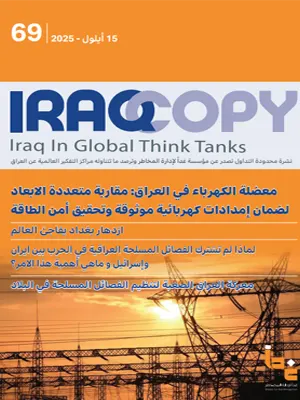
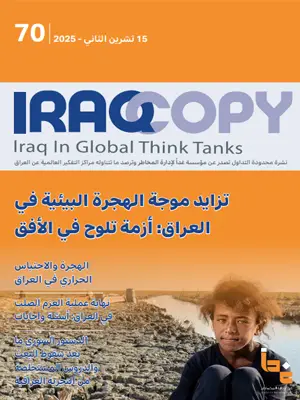

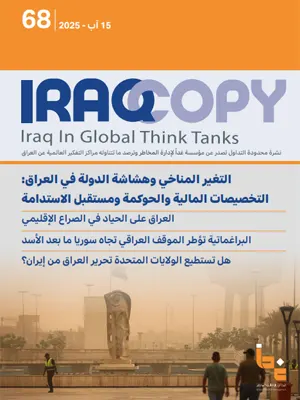
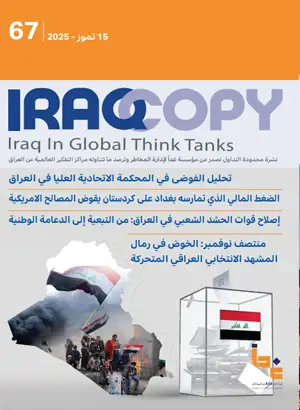

This issue ofIraqCopy includes several articles and studies on Iraq's domestic affairs and foreign policy. The first article covered in this issue is a study published on the Carnegie Endowment for International Peace website. The study, authored by researchers Joy Arkeh and Nouran Awadallah, examines the effects of climate change on Iraq and the ways in which Iraqi state institutions are adapting to deal with the repercussions.
The study, "Climate Change and State Fragility in Iraq: Financial Allocations, Governance and the Future of Sustainability" reviews the deteriorating environmental reality in Iraq in terms of high rates of desertification, drought, rising temperatures and water scarcity.
On the other hand, the report addresses the institutional efforts made by the Iraqi state and its institutions and the strategies and policies announced by these institutions to contain and address the effects of climate change and establish a sustainable economy capable of withstanding the shocks generated by the climate reality in Iraq.
This issue also contains an article by Neil Quilliam, a writer specializing in geopolitics and energy issues, titled "Iraq on the sidelines in regional conflict." The article is titled "Iraq on the sidelines in regional conflict.
The article published by the Observer Research Foundation describes Iraq's policy during the outbreak of the war between the resistance axis led by Iran on the one hand and Israel on the other as a neutral and cautious policy that sought to avoid implicating Iraq in this conflict. The author believes that the change in regional balances and the decline in Iran's influence in the region represents a real opportunity for Iraq and its leaders to strengthen state institutions internally and maximize Iraq's role externally.
"Pragmatism Frames Iraq's Position Toward a Post-Assad Syria," by Giorgio Cafiero, an assistant professor at Georgetown University. The author emphasizes that since the fall of Bashar al-Assad's regime in Syria at the end of last year, Iraq has adopted a pragmatic approach based on balance in rhetoric, openness and willingness to cooperate with the new Syria.
The article asserts that the Iraqi government, despite the existence of voices inside Iraq that oppose the normalization of relations with the Sharaa government because of its jihadist history and field activity in Iraq, insisted on opening channels of communication with the new regime, which culminated in the meeting between the Iraqi prime minister and the Syrian president in Doha last April. The author believes that the magnitude of the security, economic and strategic interests between the two countries makes it imperative for Iraq to strengthen its relations with Syria after Bashar al-Assad's regime.
Finally, the issue features an article by James D'Urso titled Can the United States Free Iraq from Iran? The article, published on the Real Clear World website, criticizes calls by some members of the US Congress to designate the Iraqi Popular Mobilization Forces as a terrorist organization and to impose financial and economic sanctions on Iraq because of its ties with Iran.
The article rejects these arguments as superficial and disconnected from reality. The author emphasizes that the Iraqi government is serious in its efforts to control the Popular Mobilization Forces and its activities.
James D'Urso adds that Iraq has proven its good intentions in activating many of the monitoring tools demanded by the United States in the field of combating money smuggling. The writer also believes that penalizing Iraq would mean losing it strategically and pushing it towards an alliance with countries competing with the United States, primarily China.
Fill in the fields, and we will contact you to complete the submission process.
comments