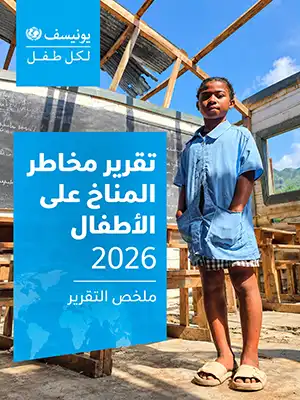
The United Nations Children's Fund (UNICEF) 2026 report on climate risks for children revealed an unprecedented increase in children's exposure to climate risks, warning that about 1.1 billion children around the world are exposed to three or more distinct climate risks, at a time when the repercussions of climate change overlap with weak health, education, water and social protection services.
Based on recent and more accurate data, the report provides a detailed picture of where children are exposed to climate hazards, the extent of their overlap and severity, as well as the ability of basic social services to protect and help children adapt to them.
And he stresses that climate hazards have remained part of natural phenomena throughout history, but global warming caused by human activities is changing the features of the world, while the frequency and severity of many of these hazards are increasing, and they often occur in overlapping ways.
Almost all the world's children are in danger
Nearly all of the world’s children are at risk from at least one climate hazard: river and coastal floods, droughts, tropical storms, heatwaves, extreme heat, fires and sandstorms.
UNICEF data reveals that about 1.8 billion children are exposed to drought, 1.5 billion to heat waves, and 1.2 billion to extreme heat, while 662 million children are exposed to tropical storms, 337 million to river flooding, 206 million to fires, 123 million to sand and dust storms, and 33 million to coastal flooding.
And the report is not limited to direct climate risks, as it also monitors climate-sensitive risks, noting that about 2.3 billion children are exposed to air pollutants, and about one billion children are at risk of malaria.
1.1 billion children at risk
And the report highlights the seriousness of the synchronization of more than one climate threat in the same place, as the climate crisis is manifested not in a single event, but in a complex series of risks that may overlap and multiply the effects of each other.
And the data indicate that 1.1 billion children are exposed to at least three climate hazards, 364 million children to at least four hazards, and 53 million to at least five hazards, while four million children face at least six hazards, and the number reaches about 123 thousand children exposed to at least seven climate hazards.
The report cites an example of this correlation with drought, which can lead to crop destruction and increased food insecurity, and then leave dry vegetation that fuels wildfires. And fires in turn exacerbate air pollution, while the land later becomes more vulnerable to flash floods that may destroy homes, schools and hospitals, and cause displacement and the spread of water-borne diseases.
Where do children face the highest risks?
The report differentiates between absolute exposure and relative exposure. In countries with large numbers of children, such as Bangladesh, India, Nigeria and Pakistan, the absolute numbers of children at multiple risk remain very high.
In contrast, the least populated States, particularly small island developing States and landlocked developing countries, can register very high levels of relative vulnerability, as the risks may involve large areas of their territory and population.
And when measuring relative exposure to multiple high-intensity hazards, the report identifies children in the Sahel region of Africa among the most affected, particularly in Burkina Faso, the Central African Republic, Mali, South Sudan and Sudan.
Children are more vulnerable to climate change
And it stresses that children bear the consequences of climate change more than others, as their still-developing bodies make dealing with physical and psychological stress more difficult, while displacement and instability caused by climate shocks increase their vulnerability.
These risks are not evenly distributed among children themselves, as the degree of fragility is affected by age, sex, disability, geographical location, socioeconomic status, as well as access to basic services.
The report identifies two key factors for a child's vulnerability to climate risk: vital sensitivity and adaptability. The latter are directly related to a child's ability to access health, food, water and sanitation, education, social protection and other services necessary for their survival and development.
Climate is putting pressure on children’s health
In the health sector, the report notes that 20 million children were denied life-saving vaccines in 2024, including 14.3 million who did not receive any dose of the diphtheria-tetanus-pertussis (DTP3) vaccine.
Climate shocks increase this vulnerability by destroying health facilities, disrupting vaccine cold chains, and increasing the spread of diseases.
In the area of nutrition, the report warns that droughts and floods are destroying crops and disrupting food supplies, raising the risk of malnutrition. It is estimated that by 2050, climate change could lead to 28 million more children being wasting and 40 million more being stunted if urgent action is not taken.
Hundreds of millions without safe water and services
And the data shows the magnitude of fragility in water and sanitation services, as in 2024, about 634 million children lacked access to safe drinking water, while one billion children lacked access to safe sanitation services, and 489 million children lacked access to basic hygiene services.
Climate shocks exacerbate this problem; Floods can contaminate water sources, while droughts dry them up, increasing children's vulnerability to disease and increasing their burdens, including bringing water.
242 million students have had their education disrupted in a year
And the report puts education at the heart of the fallout from the climate crisis: storms can destroy schools, while heatwaves disrupt schooling.
And in 2024 alone, climate-related events disrupted the education of 242 million students in 85 countries and regions.
The report warns that disruptions to education could have lifelong effects, making it difficult for children to build a stable future and emerge from cycles of poverty and fragility.
62.1 million internally displaced children
And the ramifications do not stop at health and education, as climate-related displacement and poverty increase the risks of child labor, child marriage and family dispersal.
And between 2016 and 2023, 62.1 million children were internally displaced due to climate hazards.
Climate change is expected to push more than 130 million people into extreme poverty by 2030, threatening to double the pressure on families and children, especially in low-income countries and fragile states.
A climate crisis is turning into a service crisis
And the report presents an angle beyond measuring the magnitude of the climate events themselves, as it considers that the level of risk faced by the child is determined not only by the severity of the climate event, but also by the child's vulnerability and the resilience of the services surrounding it.
When large swathes of a country are simultaneously exposed to risk, hospitals, schools, water and sanitation services, and social protection systems may be under simultaneous pressure, and the risk does not return locally, but becomes a systemic risk that affects both society and basic services.
That is why the report focuses on six key areas to enhance children's resilience: health, nutrition, WASH, education, child protection and social protection.
UNICEF calls for urgent action
And ensuring every child’s right to a clean, healthy and sustainable environment requires urgent climate policies that respond to children’s needs, backed by effective action and adequate investment.
And it calls for emissions reductions across all sectors and the fulfillment of existing international commitments based on the best available scientific evidence, including accelerating the elimination of fossil fuels, a just transition to renewable energy, and raising consumption efficiency in line with the path of reducing global warming at 1.5 °C.
It also calls for children and the essential services on which they depend to be prioritized in national adaptation plans, sector strategies, disaster preparedness and response plans, and policies to deal with loss and damage.
It further stresses the need to empower children and young people to actively participate in climate action, invest in climate education, knowledge and skills, and ensure their right to express and participate in decisions that affect their lives.
And the 2026 Children's Climate Risk Report concludes that the issue is no longer limited to children being exposed to a single climate phenomenon; The greatest risk is the accumulation of risks, their overlap with existing vulnerabilities and the weakness of basic services, which makes protecting children from the climate crisis linked to the ability of countries to build health, education and social systems that are able to withstand increasing shocks.
Full report






comments