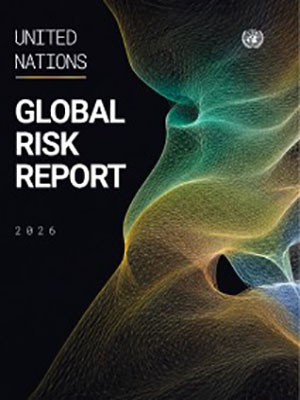
The UN Global Risks Report 2026 paints a disturbing picture of an international landscape in which political, technological, and economic risks are accelerating, as large-scale war and geopolitical tensions move to the center of global threats, and as confidence in the ability of multilateral institutions to contain a number of escalating crises declines.
The report is based on a survey of more than 1,300 participants from governments, business, civil society and the UN system, spread over 155 countries, to assess 28 global risks and compare shifts in the risk map since 2024.
36% expect a major war within a year
And the large-scale war is emerging as one of the most dangerous shifts the report has spotted, after jumping 16 places in the near-risk ranking, recording the largest rise among the risks surveyed.
And 36 percent of respondents expect a full-scale war within a year, while 76 percent expect a full-scale war within seven years.
And these percentages do not mean that the United Nations predicts the outbreak of a global war, as the report measures participants' perceptions of the likelihood of risks and their imminence, and uses forward-looking scenarios to understand the paths and decisions that may lead to major crises.
Political Risks to the Front
And the report found that political risks are more present compared to 2024, while participants' estimates of the level of readiness of multilateral institutions to face a number of these threats have declined.
The report places geopolitical tensions, large-scale war and the collapse of the rule of law at the heart of the global risk network, as factors that can cause repercussions that extend to the economy, society, security and international stability.
It also identifies geopolitical tensions as one of the most prominent pathways to a full-scale war, and links their escalation to natural resource shortages, economic fragmentation, misinformation, and weak multilateral institutions.
Artificial intelligence is rising fast.
And in parallel with political risks, concern over artificial intelligence, advanced technologies and the concentration of technological power has risen sharply compared to 2024.
And the report reveals a gap between the speed of technology development and the ability of international institutions to respond to it, as the risks of the concentration of technological power and artificial intelligence and the collapse of cybersecurity are among the risks that record low levels of institutional readiness to confront them.
This suggests that the challenge is no longer limited to the rapid spread of new technologies, but extends to the ability of governments and institutions to establish rules and mechanisms capable of managing their economic, security and social impacts.
Climate retains the lead
Despite the rise of political and military risks, inaction on climate change remained the most significant global risk in the eyes of participants.
And the report indicates a relative decline in attention to environmental risks compared to 2024, but it confirms that the low ranking of some risks does not necessarily mean a decrease in their actual seriousness, but may reflect a change in the priorities of participants as the political and security crises escalate.
Climate change also remains associated with other risks, including natural resource shortages, migration and economic and social instability.
Epidemics are declining
And in a remarkable turnaround six years after the COVID-19 pandemic, biological hazards and new epidemics recorded the largest decline in the level of attention compared to the previous survey.
Epidemics and biological hazards emerged from the list of the ten most important risks in the areas covered by the report, after they were given greater priority during the years following the Corona pandemic.
The report cautions, however, that a diminished perception of a particular risk does not necessarily mean that its causes are gone, as the results reflect participants’ perception of risk at a moment in time when priorities are changing rapidly.
The world knows the risks, but it is less able to face them
The report reveals a growing gap between the ability to diagnose and reduce risks, with participants losing confidence in the ability of multilateral institutions to reduce 23 of 28 risks over the past two years.
Eighty-six percent of respondents said funding for risk mitigation and reduction was insufficient, 79 percent said funding for recovery and reconstruction was insufficient, and 76 percent said the same about funding for disaster response.
The report identifies weak governance and coordination mechanisms, lack of political consensus, and lack of funding and data as some of the most significant obstacles to the world's ability to face growing risks.
International cooperation remains the key
And despite the alarming picture, participants see intergovernmental action as still the most effective way to counter global threats, particularly wars, geopolitical tensions and weapons of mass destruction.
Economic and technological risks, such as financial crises, supply chain disruptions, artificial intelligence and cybersecurity, require broader cooperation between governments and the private sector.
The UN Global Risk Report 2026 concludes a rapidly transforming international landscape; War is getting closer to participants’ perceptions, artificial intelligence is advancing faster than institutions are ready to regulate it, and climate change retains its position as the most important global threat.
And between the rise of political and technological tensions and the decline in the ability to confront them, the report’s main message seems clear: the world is becoming more capable of identifying risks, but it still needs more effective cooperation, funding, and institutions to prevent them from turning into major crises.
Full report




comments