With wars, economic crises, climate change, and rapid technological developments, the concept of "risk" is no longer limited to natural disasters or military conflicts, but has become a comprehensive framework that determines the course of the global economy and international security in the coming years.
And the World Economic Forum’s Global Risks Report 2026 reflects this shift, describing the current phase as the second half of a “turbulent decade,” in which geopolitical, economic, environmental and technological risks overlap in ways that make crisis management more complex than ever.
The report not only provides a list of risks, but also maps their interaction, explaining how a single crisis can turn into a cascade of economic, security and humanitarian crises, forcing governments and institutions to rethink their planning and risk management methods.
A paradigm shift in the nature of threats
The report’s findings indicate a clear change in global risk priorities compared to previous years.
While climate change and pandemics have dominated the list of threats over the past years, the geo-economic confrontation in 2026 has become the most urgent threat, ahead of military conflicts and natural disasters.
And this reflects the escalation of competition between the major powers, the return of protectionist policies, high tariffs, and the disruption of global supply chains, which are now directly affecting the stability of markets, energy and international trade.
The report also highlights the rise of misinformation, societal polarization, and cyber threats as factors that can destabilize countries politically and economically, even in the absence of direct military conflicts.
The global economy is at risk
The report shows that economic risks are no longer the result of traditional market slowdowns, but rather linked to intertwined geopolitical and technological factors.
The trade confrontation between the major powers, the possibility of lower expected economic returns from artificial intelligence technologies, higher inflation, and the formation of new financial bubbles, all of which have led experts to raise the level of economic risks in an unprecedented way.
And the report warns that any dip in AI-related investments could lead to a sharp correction in financial markets, with the impact extending to production sectors, supply chains and consumer spending.
The environment... the most sustainable risk
And despite the rise of economic risks in the short term, the report stresses that climate change remains the biggest threat over the next decade.
And the data on which the report is based indicate that the last three years have recorded the highest temperatures in modern history, coinciding with rising ocean temperatures, accelerating Arctic ice melt, and the expansion of extreme weather events.
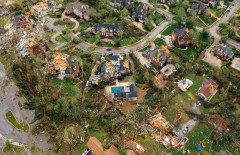
And this was reflected in a series of natural disasters in 2025, including widespread flooding in Asia and the United States, unprecedented wildfires in Europe and Canada, and extended droughts in the Horn of Africa and the Middle East.
These indicators underscore the transition of environmental risks from the stage of probability to the stage of reality, posing direct challenges to food and water security, energy and social stability.
Serial risks... the most serious threat
One of the highlights of the 2026 report is its focus on the concept of chain risks, which is that crises are no longer separate, but each risk is able to produce other risks.
A breakdown in the electricity grid could bring water systems to a halt, communications to a halt, financial markets to be disrupted, and health services to be affected simultaneously.
And the report notes that increasing reliance on digital systems is making global infrastructure more sensitive to cyber attacks, natural disasters and geopolitical crises.
And more than half of the experts in the report predicted major disruptions to critical infrastructure over the next two years, while this percentage rises to about 70% over the next ten years.
Implications for Developing Countries
And while the report addresses risks globally, its implications appear to be more severe in developing economies, which rely on a single economic resource or on limited trade corridors.
Disruption of trade routes, energy markets or supply chains can lead to significant financial losses, increase pressures on public budgets, and affect food security and social stability.
Countries that rely heavily on water infrastructure or hydropower, including Iraq, Jordan, Syria and Morocco, will be at higher risk of climate change and drought.
From Crisis Management to Building Resilience
The report not only diagnoses risks, but calls for a change in the philosophy of crisis management, by building more resilient systems.
His priorities include:
Diversify energy sources and reduce dependence on fossil fuels.
Increase investment in renewable energy and green hydrogen.
Modernization of critical infrastructure.
Enhancing cybersecurity.
Development of early warning and disaster management systems.
Support international cooperation in the face of cross-border crises.
Develop regulatory frameworks for artificial intelligence and emerging technologies.
The report also emphasizes that the success of these efforts depends on a genuine partnership between governments, the private sector and international institutions, as global risks have become too complex for one to manage on its own.
Risk assessment summary
A reading of the Global Risks Report 2026 reveals that the world has entered a new phase in which crises are no longer separate events, but rather an interconnected system in which politics, economics, climate, and technology interact in a way that makes risks more complex and broader.
And the report’s main message is that the biggest threat is not the presence of risk itself, but the lack of institutional willingness and capacity to build and adapt to it. And countries and institutions that invest in risk management, diversify their economic sources, and enhance their environmental and technical security will be better able to turn challenges into opportunities, while economies that are less prepared will remain more vulnerable to repeated shocks over the coming years.



comments