Introduction:
In modern warfare, it is no longer nuclear weapons or ballistic missiles that decide battles. The "energy weapon" has emerged as the hidden and decisive factor, used as a silent but effective geopolitical weapon. In light of escalating international crises, from Ukraine to the Middle East, from the China Sea to the Gulf, controlling energy sources and directing their flows has become a means of subjugation or resistance, or even the "last bullet" that may be fired after all other means have been exhausted.
It has been silently and cleverly used as a tool of deterrence, blackmail, bartering, and even the "last bullet" that may be fired after other means have been exhausted.
The American Stratfor Center has noted that "the 21st century will be the century of energy as the 20th century was the century of industry," as energy is no longer just an engine of the economy, but a tool of influence and conflict. In light of the escalation of global conflicts and the complexity of international relations, the "energy weapon" has become one of the most important tools of geopolitical power.
It was transformed from a mere economic resource into a means of pressure, deterrence, and influence, and was even described as the "last bullet in the war." Although Iraq possesses huge oil and gas reserves, its poor strategic structure and mismanagement have rendered it unable to effectively utilize this power.
Although Iraq is one of the largest oil producers in the world, possesses reserves estimated at more than 145 billion barrels of oil, and has a pivotal geopolitical location connecting the Arabian Gulf to Turkey, Iran, and Syria, it has yet to exploit this geopolitical power as a strategic tool in foreign or even domestic policy.
Current geo-energy realities
- Oil production: About 3.3 - 3.5 million barrels per day (OPEC, 2024)
- Export rate: More than 90% of Iraq's oil is exported unrefined
- Oil resources account for: More than 95% of the country's revenues
- Lack of infrastructure: Iraq lacks modern refineries, sophisticated export ports, and pipelines connecting it to its neighbors (with the exception of the long-suspended Turkish Ceyhan line).
Structural Challenges to Weaponizing Energy
1. Absence of a national energy strategy: There is still no unified Iraqi vision for the use of energy resources within a comprehensive national security project.
2. Rentier economy and loss of productive will: Iraq relies solely on the export of crude oil without the development of non-oil sectors or energy-related industries, making it hostage to market fluctuations.
3. Structural corruption: According to the report of the Iraqi Integrity Commission (2023), 10-15% of oil revenues are wasted annually through corruption networks in contracts and collection.
4. Gas flaring: Iraq burns more than 50 percent of the gas associated with oil extraction, despite the fact that it is badly needed to produce electricity (World Bank, 2023).
5. Dependence on Iranian gas: Iraq imports about 40 percent of its gas from Iran for electricity generation, which puts it in a weak negotiating position and jeopardizes its energy security when pumping is interrupted due to sanctions or political disputes.
The concept of an "energy weapon"
An energy weapon is the strategic use of energy resources (oil, gas, electricity, and associated trade corridors) as a tool for political or economic pressure on adversaries or allies.
This concept has been evident since the 1973 October War, when the Arabs used the weapon of oil to pressure the West, but today it is back with a more complex and clever twist. Says Henry Kissinger:
"He who owns the energy, owns the decision... He who controls its flow controls the destiny of nations." Henry Kissinger said in an interview with The Atlantic (2014):
Whoever controls energy flows can change geopolitics without firing a shot."
Why is it the "last bullet"?
Because states often reserve this weapon for the moment when all other tools of pressure become ineffective or too costly. They use it when they have no other options, or when they want to achieve maximum impact at minimum cost.
Real life examples:
1. Russia and Europe (2022-2023): Moscow cut off gas supplies to EU countries amid the Ukraine war, leading to a severe energy crisis and a harsh winter in Europe.
2. Russian gas exports to Europe fell by 80% in one year (Bloomberg, 2023).
3. Iran and America: US sanctions on Iranian oil exports have reduced production from 3.8 million barrels per day to less than 2.5 million in periods of maximum sanctions (EIA, 2022). Tehran has responded by threatening navigation in the Strait of Hormuz, through which more than 20 percent of global oil trade passes.
4. China and Australia: In 2021, China used a ban on Australian coal and gas imports as leverage after political disagreements, affecting Asian energy markets.
5. III: Energy Weapon Tools
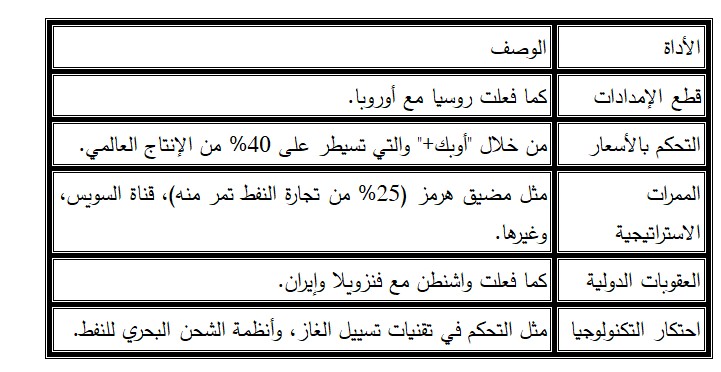
The Future of Energy Weaponry
Despite the global shift to clean energy, oil and gas will remain at the center of global energy consumption until 2040, according to the International Energy Agency (IEA).
Strategic forecasts:
- Brookings Institution (2023): Energy will remain one of the most important tools of geopolitical conflict through 2050, especially in light of U.S.-Chinese competition for resources in Africa and Asia.
- International Monetary Fund: Energy crises will recur every 3-5 years due to unstable supply chains and monopolized production.
- Council on Foreign Relations (CFR): There is a shift from a fossil energy weapon to a "rare metals weapon" as green industries develop.
Risks and challenges
- Economic blowback: As happened in Russia, the use of an energy weapon can lead to sanctions or international isolation.
- Acceleration in alternative energy: This could gradually reduce the importance of oil and gas.
- Weak infrastructure: In some producing countries (e.g. Iraq and Libya) makes threats less effective.
Iraq and the Energy Weapon
Iraq has enormous potential that would make it a pivotal player in the global energy map, but it does not utilize it within a clear national strategy. Rather, the absence of a "strategic energy mind" has allowed this resource to turn from a strength to a weakness, exploited by regional and international interventions. The religious authority in Najaf has emphasized on more than one occasion that
"The need to use the country's resources to serve the people, not to loot them or leave them as a tool for foreign conflicts."
What does Iraq really need?
In order for Iraq to turn energy into a "positive geopolitical weapon," a comprehensive shift in the philosophy of managing this resource must be achieved through the following axes:
1. Formulating a national energy doctrine
Iraq should formulate an "energy doctrine" as part of its national security strategy, outlining the following objectives:
- Achieving internal energy security (electricity and fuel sufficiency)
- Building regional energy alliances (with Turkey, Jordan, Gulf states)
- Diversifying export markets (expanding eastward to Asia)
2. Utilizing natural gas instead of burning it
- Iraq burns the equivalent of $500 million worth of gas every day due to the lack of infrastructure.
- Investing in associated gas gathering and processing projects could save more than $6 billion annually and reduce dependence on imports.
3. Diversify export tools
- Developing the Basra-Aqaba project to transport oil to the Red Sea
- Building alternative export ports in the south (Greater Faw)
4. Establish an independent national energy council
- Oversees all energy policies
- Independent experts and parliamentary accountability
- Coordinates between the ministries of oil, electricity, planning, and foreign affairs
5. Integrating energy into foreign policy
- Energy should not only be a financial resource, but a tool of diplomatic influence.
Example: Iraq could offer gas to Kuwait in exchange for investments, or oil to Jordan in exchange for security partnerships.
6. Switching to renewable energy
- Iraq's sun and wind are among the highest in the world, but the contribution of renewable energy does not exceed 1%. Gradual reliance on clean sources will provide a surplus of oil and gas for strategic export.
A regional view: Iraq between its neighbors and a rising India
While Iraq has enormous energy resources, its neighbors are making good use of energy in their economic and political strategies. Iran, despite sanctions, maintains the world's largest gas reserves and uses them as a regional leverage, while Saudi Arabia, through Aramco and Vision 2030, is leading a strategic shift towards diversifying the economy and expanding the influence of renewable energy and green hydrogen. Turkey, despite its dependence on imports, has turned into a transit hub for regional energy through mega projects with Russia and Azerbaijan, while Jordan and Kuwait seek to maximize the added value of energy despite limited resources or a small market.
On the other hand, the Indian economy is emerging as an emerging global power that relies heavily on energy imports, as it is the third largest consumer of energy globally, and has a strategic relationship with Iraq as one of its largest importers of oil. This global shift towards developing Asian markets requires Iraq to not only export crude, but to develop its tools and position itself as an effective regional hub in the energy equation.
On the other hand, the Indian economy is emerging as an emerging global power that relies heavily on energy imports, as it is the third largest consumer of energy globally, and has a strategic relationship with Iraq as one of its largest importers of oil. This global shift towards developing Asian markets requires Iraq to not only export crude, but to develop its tools and position itself as an effective regional hub in the energy equation.
Conclusion
In a world where conflicts are escalating and interests are intertwined, the "energy weapon" becomes the last bullet that may change the course of a war or decide the fate of a negotiation. Those who know how to use it don't necessarily need to shoot... It may even be enough to threaten to turn off the light bulb. The energy weapon is indeed the "last bullet in war," but it can also be the "first bullet in the battle for economic and political independence." Those who use this weapon well - with intelligence, timing, and alliance networks - can change the rules of the international game. Those who overplay it will lose their voice before they have even fired a shot, as energy expert Daniel Yergin put it: "Wars are fought with oil as well as guns, but victory is decided by the ability to control both."
Sources:
1. International Energy Agency (IEA), World Energy Outlook, 2023
2. معهد بروكينغز – Brookings Institute, Energy and Geopolitics Report, 2023
3. Bloomberg, Russian Gas Crisis Report, 2023
4. U.S. EIA report, Iranian Oil Exports, 2022
5. Henry Kissinger, The Atlantic interview, 2014
6. Stratfor, Energy Forecast, 2021
7. IMF, Energy Risks, 2022
8. Council on Foreign Relations CFR, 2024
9. OPEC data, April 2024 report
10. Najaf religious authority, Friday sermon, 2018
By Prof. Dr. Fadi Hassan Jaber




comments