Concerns about energy security risks increase in light of the transformation and transition process, in line with global climate and environmental goals, and the commitments and pledges of governments, states and policymakers, and the risks in the Middle East and North Africa may be more acute, in light of a difficult equation that includes the availability of potential and the lack of investments at the same time.
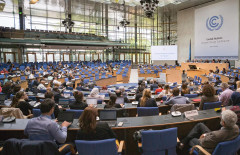
Dr. Sara Fakhshouri, Director of the Center for Energy Security, Diplomacy and Global Policy Institute and President of SVP Energy International, highlighted these risks during her participation in the third conference of the International Society for Energy Economics, and stressed the role of the region in addressing energy security risks.
Energy Security Risks in the Middle East and Africa
Dr. Sara Fakhshouri said that energy security risks in the region's markets have 5 themes:
1) Uncertainty:
Despite the uncertainty around securing transitions and energy security risks, Dr. Sara Fakhshouri is optimistic that the region can contribute to addressing the risks surrounding security of supply.
She explained that from a strategic perspective, the uncertainty is clearly visible in market data and expectations.
Each country has its own energy transition roadmap, but with data lagging behind, policies are preceded by policies without a clear understanding of the requirements of the transition.
She cited the rapid change in consumer behavior towards "electrification," which adds to the uncertainty, and noted that energy markets are facing demand pressure, including demand for renewable energy and metals.
2) Market narrative:
The current market trend is linked to "narratives", which are subject to many interpretations as there is a "gap" between expectations and available data, which in turn affects the market.
Dr. Fakhshouri gave the example of the difference in demand growth estimates between OPEC and IEA projections.
Demand growth projections must take into account variables such as: "the economic situation and population growth," noting that the wide data gap allows for many interpretations between hope and reality.
Last week's OPEC+ meeting coincided with US inventories - both oil and gasoline - falling to their lowest levels since the summer.
At the same time, Fakhshuri pointed out that oil prices fell and several futures contracts were signed, explaining that these variables without standardized data affect investor sentiment.
3) New technologies:
Dr. Sara Fakhshouri warned that new technologies, such as artificial intelligence, have difficulties in predicting their demand and being included in influential market forecasts.
She explained that U.S. electric companies do not have data and information about the amount of electricity to be distributed in the future, as the specific demand for new technologies is still limited to data centers, and does not include AI tools in their entirety.
She cited the state of Virginia, which needs about 24 additional gigawatts to meet data center demand - just for electricity - by 2034.
These quantities are equivalent to the output of between 26 and 30 nuclear power plants, reflecting the rapid transition to a cleaner, more sustainable world with "uncertainty".
4) Power justice:
Dr. Sara Fakhshouri stressed that equity in resource distribution is difficult in light of "energy poverty," accessibility, and the energy-food nexus.
The relationship between the two needs to be carefully considered as decarbonization demands negatively impact the availability of fertilizers, she said.
She cited the case of Madagascar in Africa, which tried to compensate for fertilizer shortages with deforestation.
5) Carbon calculation:
Dr. Sara Fakhshouri said that carbon accounting is one of the most significant energy security risks in the Middle East and North Africa (MENA) region.
Countries that produce or use desalination, or other essential activities, need a clear way to calculate carbon relative to other regions and industries.






comments